Open Research Data Program of the ETH Board
proposal for an open metadata dataset
May 12, 2025
Measure 1: Calls for Field-Specific Actions
- 11 calls for proposals
- 96 funded projects (60 Contribute, 34 Explore, 2 Establish)
- X.X million CHF in funding
Data from:
Program evaluation
- Who are the researchers that received funding?
- Which institutions are they employed at?
- Which disciplines do they represent? kind of
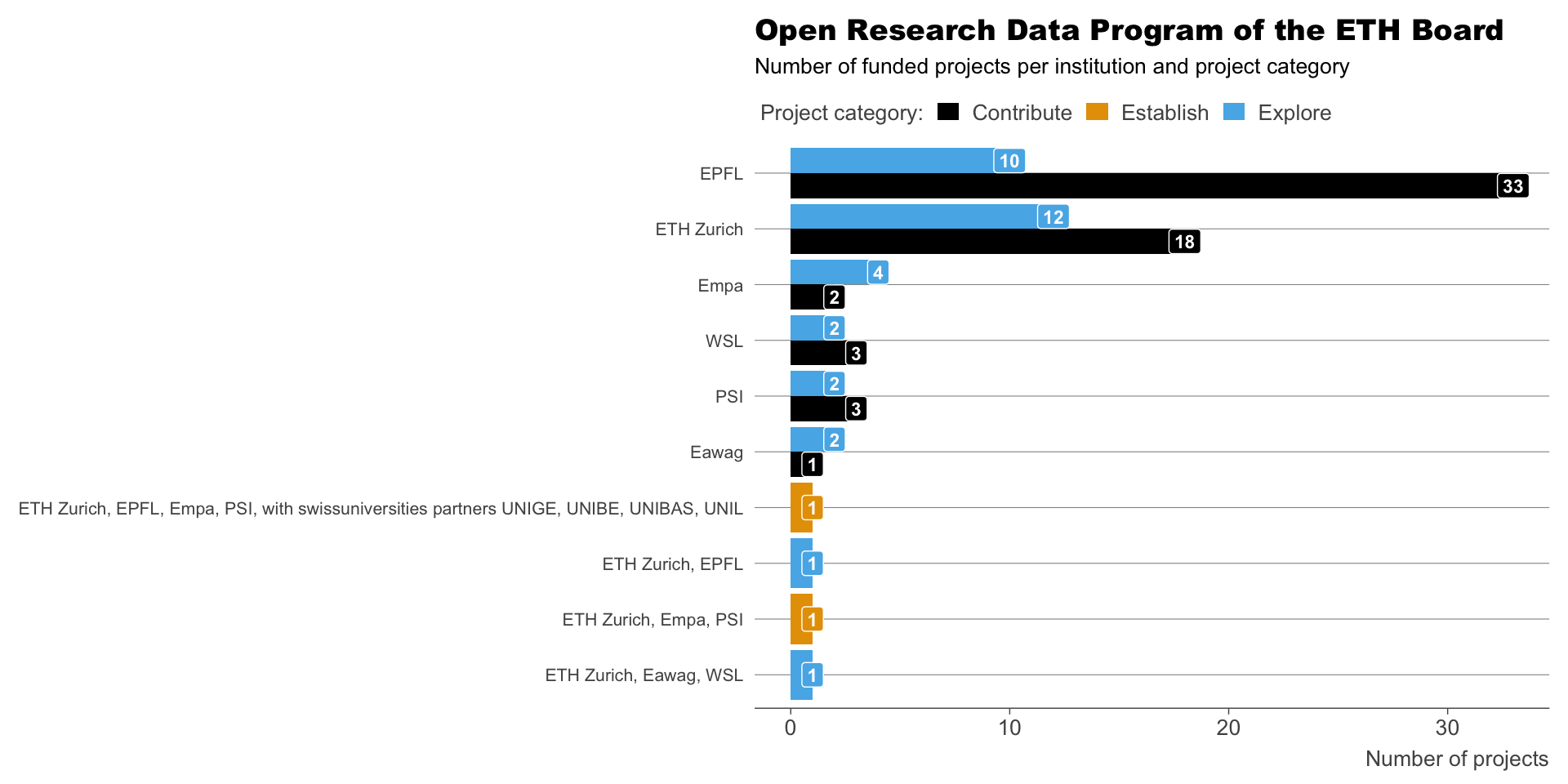
Program evaluation
- Who are the researchers that received funding?
- Which institutions are they employed at?
- Which disciplines/fields do they represent? kind of
- What is their scientific role (e.g. Professor, Post Doc, PhD, etc.)?
- How many publications are derived from these projects?
- How many ORD datasets have been published?
- How where budgets distributed among their cost categories?
- How many proposals were submitted to each call? And how many received funding?
- etc.
Problem statement
A metadata dataset that brings together all the information from the ETH ORD programme is currently not available.
Proposed solution
Project relevant internal data sources (e.g. submitted proposals, final scientific reports, MS Excel files, Email exchange, online research) will be used to prepare a set of metadata datasets.
Make it Open and FAIR
In the spirit of ORD, the metadata datasets will be shared as open research data, following FAIR principles for data sharing.
- permissive license (CC0)
- assigned DOIs
- rich documentation
- various formats (e.g. CSV, XLSX, R data package)
- curated (stand-alone website)
- etc.
- Findable
- unique identifiers (e.g. DOIs)
- metadata
- persistent URLs
- Accessible
- open access
- no login required
- no restrictions on use
- Interoperable
- machine-readable
- standard formats (e.g. CSV, JSON, XML)
- standard vocabularies (e.g. schema.org)
- Reusable
- clear usage rights
- clear provenance
- clear licensing
- clear attribution
SNFS Grants database
Not FAIR, but open:
Datasets
At minimum, the following datasets are suggested, which can be combined by unique identifier (proposal_id):
Dataset: proposals
- call_id
- call_category
- proposal_id
- proposal_url (if proposal is public somehere)
- acronym
- title
- abstract
- funding_requested
- funding_received
- panel_score_excellence_reviewer1
- panel_score_implementation_reviewer1
- panel_score_impact_reviewer1
- panel_score_excellence_reviewer2
- panel_score_implementation_reviewer2
- panel_score_impact_reviewer2
- acceptance (yes/no)
- main_applicant_name (if too for rejected proposals, remove from ORD data, but keep internal resource)
- main_applicant_institution_name
- main_applicant_department_name
- main_applicant_lab_name
- co_applicant_name (if too for rejected proposals, remove from ORD data, but keep internal resource)
- co_applicant_institution_name
- co_applicant_department_name
- co_applicant_lab_name
Dataset: proposals - Sources
- Project proposals (accepted & rejected)
- Internal MS Excel files for scores
- Email exchange
- Online research
Note: If access to rejected proposals is not possible, a fourth dataset calls is suggested.
Dataset: projects
- proposal_id
- project_start
- project_end
- no_cost_extension
- project_website
- budget_cost_category_senior_staff
- budget_cost_category_postdocs
- budget_cost_category_students
- budget_cost_category_other
- budget_cost_category_publications
- budget_cost_category_conferences_workshops
- budget_cost_category_other
- budget_sub_contracting_costs
- etc.
Dataset: projects - Sources
- Project proposals
- Scientific reports
Dataset: outputs
- proposal_id
- category (e.g. website, publication, dataset, software, etc.)
- repository_catalogue
- etc.
Dataset: outputs - Sources
- Scientific reports, list of outputs
- Email exchange
Dataset: calls
A summary table:
- call_id
- call_category
- outcome_total (e.g. accepted, rejected)
- value
Thanks!
Slides created via revealjs and Quarto: https://quarto.org/docs/presentations/revealjs/
Data (Nicoló Massari) available at: https://raw.githubusercontent.com/Global-Health-Engineering/ethord/refs/heads/main/data/data.csv
Access slides as PDF on GitHub