| variable_name | variable_type | description |
|---|---|---|
| project_id | numeric | A unique identifier for each project, represented as a numerical value. |
| cost_personnel_senior_staff_fr | logical | The cost of personnel for senior staff in Swiss Francs (CHF), expected to be a numerical value. |
| cost_personnel_postdocs_fr | numeric | The cost of personnel for postdoctoral researchers in Swiss Francs (CHF), represented as a numerical value. |
| cost_personnel_other_fr | numeric | The cost of personnel for other staff members in Swiss Francs (CHF), represented as a numerical value. |
| cost_personnel_students_fr | logical | The cost of personnel for students in Swiss Francs (CHF), expected to be a numerical value. |
| cost_travel_fr | numeric | The cost of travel expenses in Swiss Francs (CHF), represented as a numerical value. |
| cost_equipment_fr | numeric | The cost of equipment in Swiss Francs (CHF), represented as a numerical value. |
| cost_publication_fr | logical | The cost of publication expenses in Swiss Francs (CHF), expected to be a numerical value. |
| cost_social_fr | numeric | The cost of social expenses in Swiss Francs (CHF), represented as a numerical value. |
| cost_other_fr | numeric | The cost of other expenses in Swiss Francs (CHF), represented as a numerical value. |
| cost_subcontracting_fr | numeric | The cost of subcontracting in Swiss Francs (CHF), represented as a numerical value. |
ethord
Publishing Open Metadata for Open Research Data Projects of the ETH Domain
• Swiss Open Academic Data (SOAD) Day •
• ghe-open.ch/slides •
Lars Schöbitz 
Nicoló Massari
Prof. Elizabeth Tilley
September 10, 2025
ETH Domain Open Research Data (ORD) Program
Hands-up
Who has heard of the ETH Domain Open Research Data Program?
Measure 1: Calls for field specific actions
“The primary goal of the measure is to support ETH researchers to engage in, and develop ORD practices and to become ORD leaders in their fields”
Projects
15 mio CHF in funding
96 funded projects
Metadata
Metadata: ORD portal
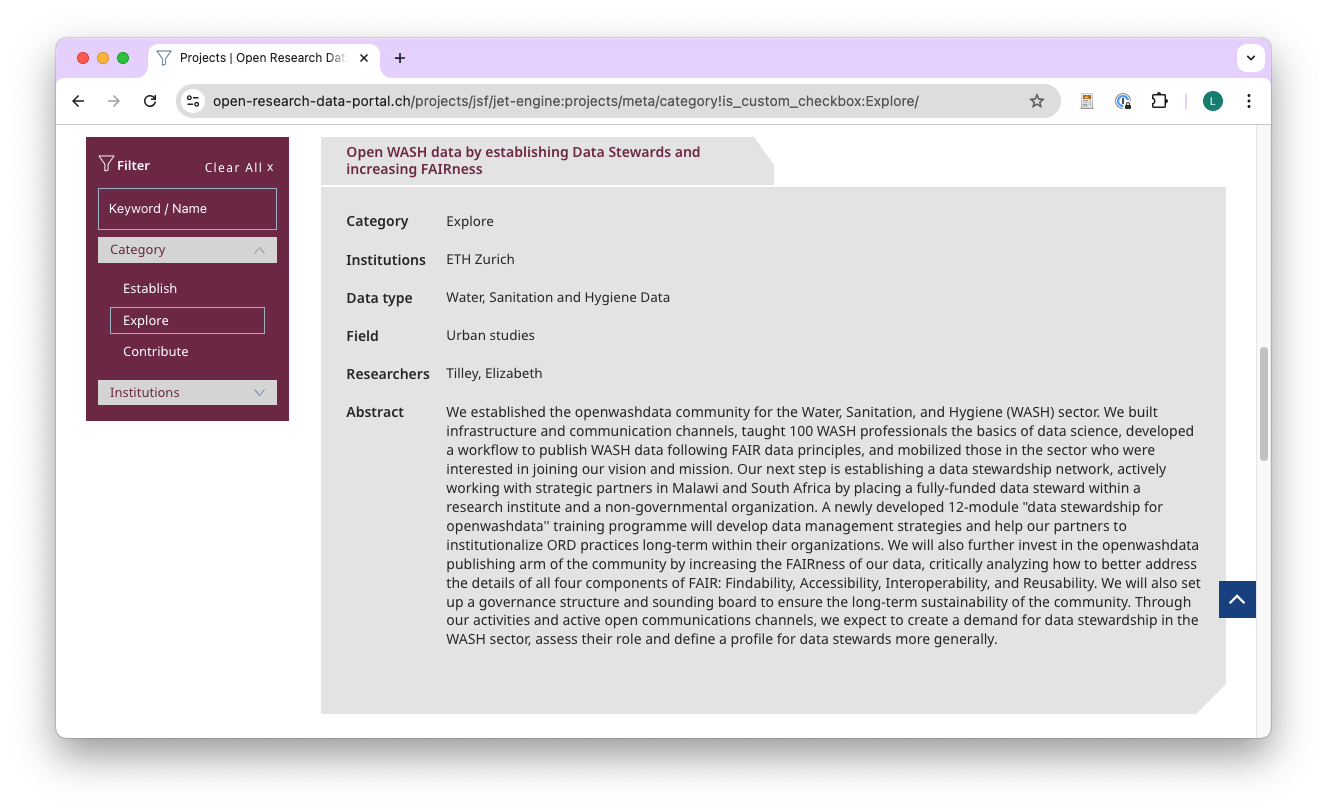
Metadata: ORD portal
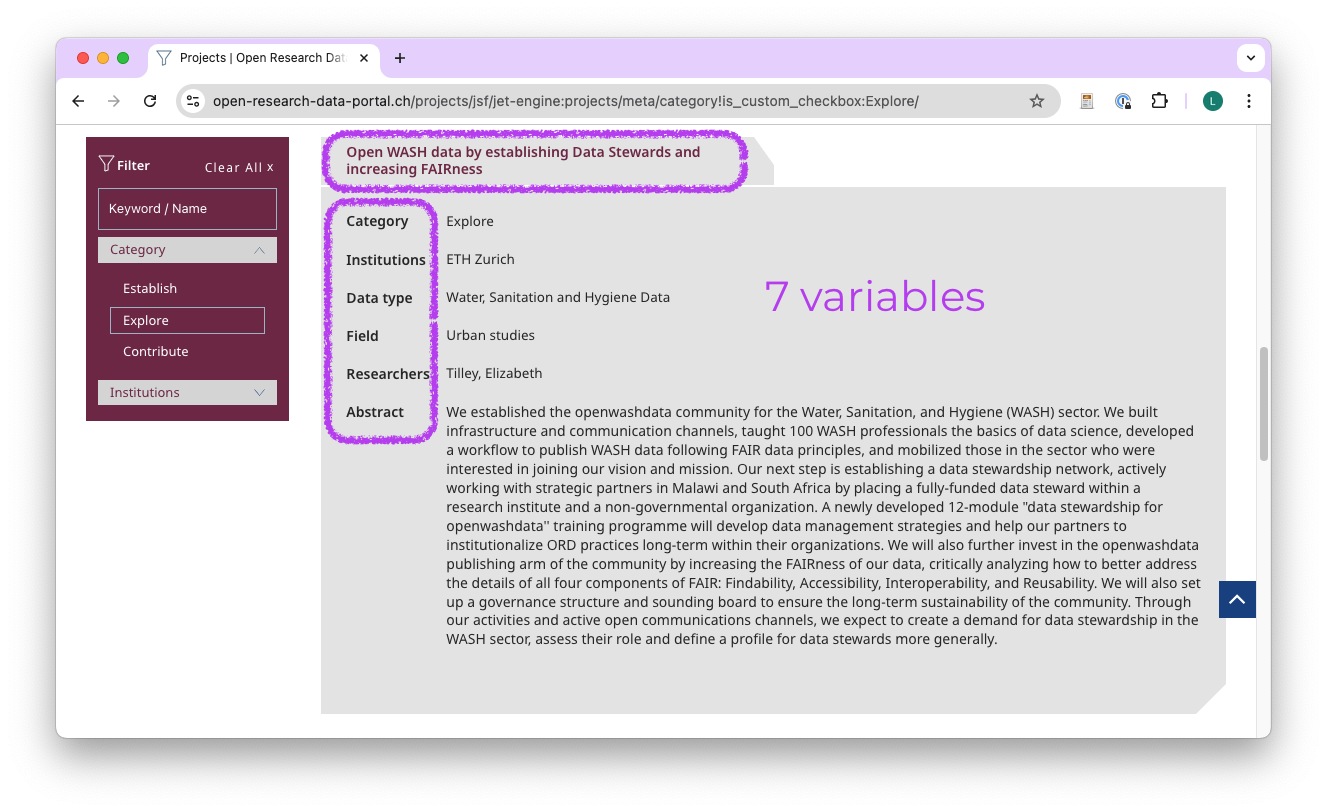
- Portal shows titles, abstracts, institutions, applicant names
- No structured bulk data or programmatic access
- Limited visibility of reports and outputs
- No systematic tracking of project outcomes
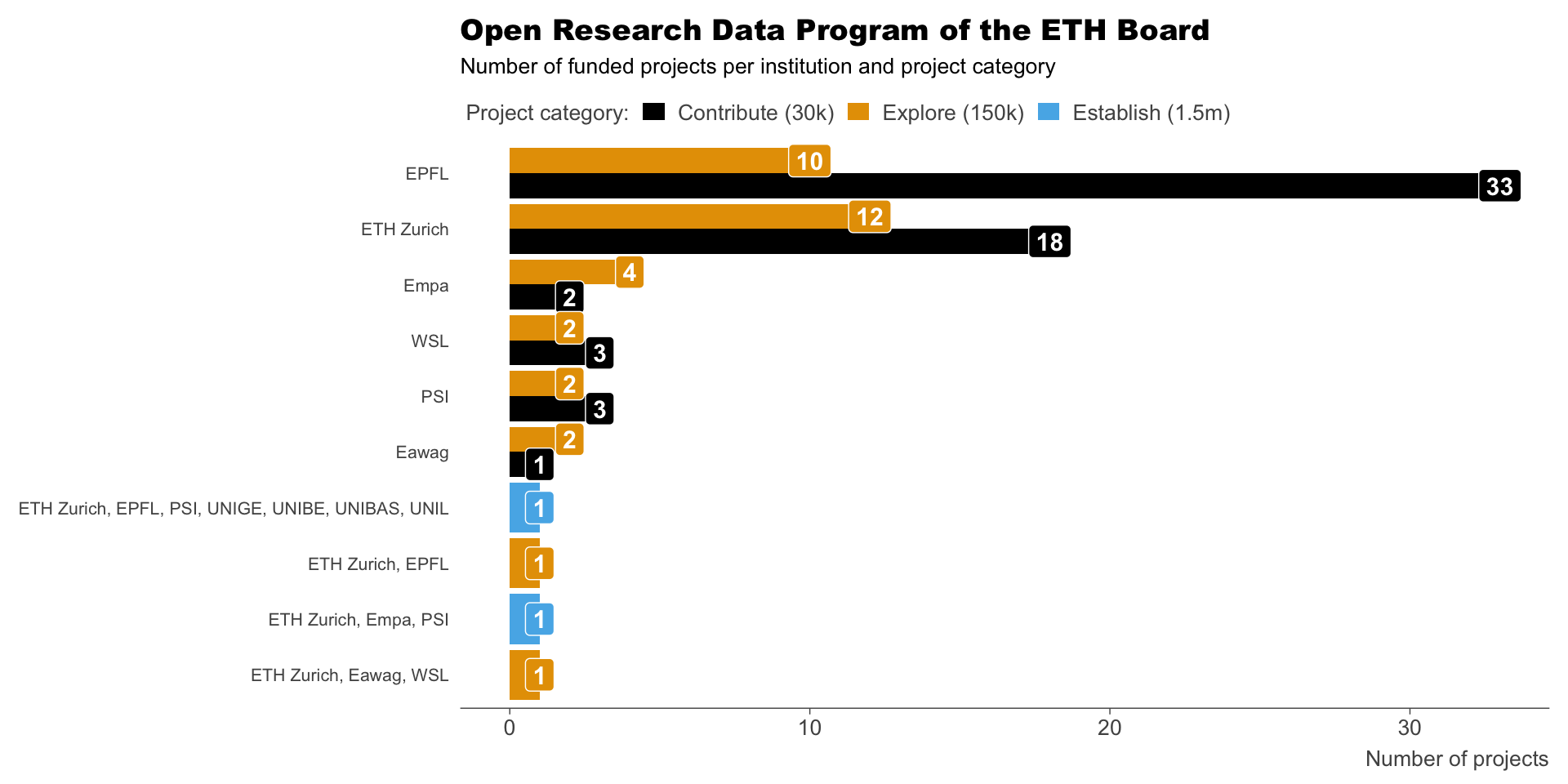
Data from: Massari et al. (2025)
Metadata (not public)
Proposals & Reports & List of Outputs
- What is their scientific role (e.g. Professor, Post Doc, PhD, etc.)?
- How were budgets distributed among their cost categories?
- How many publications are derived from these projects?
- How many ORD datasets have been published?
- etc.
Limitation
- proposals, scientific reports, and lists of outputs are not available as
- open
- structured
- machine-readable
- data
The Real Limitation
- proposals, scientific reports, and lists of outputs are:
- confidential
- only available to EPFL Research Office
- protected as intellectual property by researchers
Consequences
- Limits discoverability and impact assessment
- Reviewers have privileged access while public cannot evaluate program effectiveness
- Contradicts goal of helping researchers become ORD leaders
Solution
- Ask all applicants for permission to extract metadata from project documentation
- We are experts in FAIR data sharing principles, so let’s do it!
- Publish FAIR-compliant, DOI-assigned metadata dataset
ethord R data package
ethord
- https://global-health-engineering.github.io/ethord/ (Massari et al. 2025)
- R data package with four tables
- open source development (GitHub)
- permissive license (CC-BY)
- assigned DOI (Zenodo)
Resource: docs_proposal
Question: How much money was spent in each cost category?
library(ethord)
library(dplyr)
library(tidyr)

# data wrangling to get sub-categories

docs_proposal_long <- docs_proposal |>
  pivot_longer(cols = !project_id,
               names_to = "cost_category",
               values_to = "CHF") |>
  mutate(cost_sub_category = case_when(
    str_detect(cost_category, "personnel") ~ "personnel",
    str_detect(cost_category, "travel") ~ "travel",
    str_detect(cost_category, "equipment") ~ "equipment",
    str_detect(cost_category, "publication") ~ "publication",
    str_detect(cost_category, "social") ~ "social",
    str_detect(cost_category, "subcontracting") ~ "subcontracting",
    .default = "other"
  ))

# data summary to display table output
docs_proposal_long |>
  filter(!is.na(CHF)) |>
  group_by(cost_sub_category) |>
  summarise(sum_costs = sum(CHF)) |>
  mutate(percent = sum_costs / sum(sum_costs) * 100) |>
  arrange(desc(sum_costs)) |>
  gt() |>
  tab_header(
    title = "ORD Program Budget Distribution",
    subtitle = "Cost breakdown across 4 funded projects"
  ) |>
  cols_label(
    cost_sub_category = "Cost Category",
    sum_costs = "Total (CHF)",
    percent = "Percentage"
  ) |>
  fmt_number(
    columns = sum_costs,
    decimals = 0,
    use_seps = TRUE
  ) |>
  fmt_percent(
    columns = percent,
    decimals = 1,
    scale_values = FALSE
  ) |>
  tab_style(
    style = list(
      cell_text(weight = "bold")
    ),
    locations = cells_column_labels()
  ) |>
  tab_options(
    table.font.size = px(14),
    heading.title.font.size = px(18),
    heading.subtitle.font.size = px(14)
  )
Data from: Massari et al. (2025)
Question: How much money was spent in each cost category?
| ORD Program Budget Distribution | ||
| Cost breakdown across 4 funded projects | ||
| Cost Category | Total (CHF) | Percentage |
|---|---|---|
| personnel | 281,835 | 78.3% |
| subcontracting | 36,000 | 10.0% |
| travel | 22,570 | 6.3% |
| social | 16,900 | 4.7% |
| other | 2,000 | 0.6% |
| equipment | 600 | 0.2% |
Product: A public website
Future Possibilities
How could we make such administrative data “open by default” in the future?
Swiss Open by Default Policy Framework
Federal Foundation: Open Government Data Strategy 2019-2023 (Swiss Federal Council 2019) established “open by default” principle for all federal agencies
Legal Mandate: Federal Act EMBAG Article 10 (Federal Act on the Use of Electronic Means for the Fulfilment of Government Tasks (EMBAG) 2024) legally requires open data publication unless restricted by privacy or security
Implementation: OGD Masterplan 2024-2027 (Federal Statistical Office 2024a) operationalizes through:
- Progressive data opening with documented exceptions
- Quality standards aligned with FAIR principles (Wilkinson et al. 2016)
- Centralized coordination via opendata.swiss (Federal Statistical Office 2024b)
- Standardized metadata using DCAT-AP CH (Federal Statistical Office 2023)
Thanks!
Slides at:
Slides created via revealjs and Quarto: https://quarto.org/docs/presentations/revealjs/
Data (Nicoló Massari) available at: Massari et al. (2025)
Access slides as PDF on GitHub
References
Federal Act on the Use of Electronic Means for the Fulfilment of Government Tasks (EMBAG) (2024). https://www.fedlex.admin.ch/eli/cc/2023/682/en.
Federal Statistical Office. 2023. DCAT Application Profile for Data Portals in Switzerland (DCAT-AP CH). https://www.dcat-ap.ch/.
Federal Statistical Office. 2024a. Open Government Data Masterplan 2024-2027. https://www.bfs.admin.ch/bfs/en/home/services/ogd.html.
Federal Statistical Office. 2024b. Opendata.swiss: Swiss Open Government Data Portal. https://opendata.swiss/.
Massari, Nicolo, Lars Schöbitz, and Elizabeth Tilley. 2025. Ethord: ETH Board Open Research Data (ORD) Program Project Metadata and Report Data. Version 0.0.3. https://doi.org/10.5281/zenodo.16563064.
Swiss Federal Council. 2019. Open Government Data Strategy Switzerland 2019-2023. https://www.admin.ch/gov/en/start/documentation/media-releases.msg-id-74641.html.
Wilkinson, Mark D et al. 2016. “The FAIR Guiding Principles for Scientific Data Management and Stewardship.” In Scientific Data, vol. 3. https://doi.org/10.1038/sdata.2016.18.